
The Bitumen Mastic is an intimate homogeneous mixture of mineral fillers and well graded fine and or coarse aggregate with hard grade bitumen, cooked and laid hot, trowelled and floated. This mixture then settles to a coherent, void less and impermeable solid mass under normal temperature conditions.
Ingredients of Bitumen Mastic:
1. Bitumen:
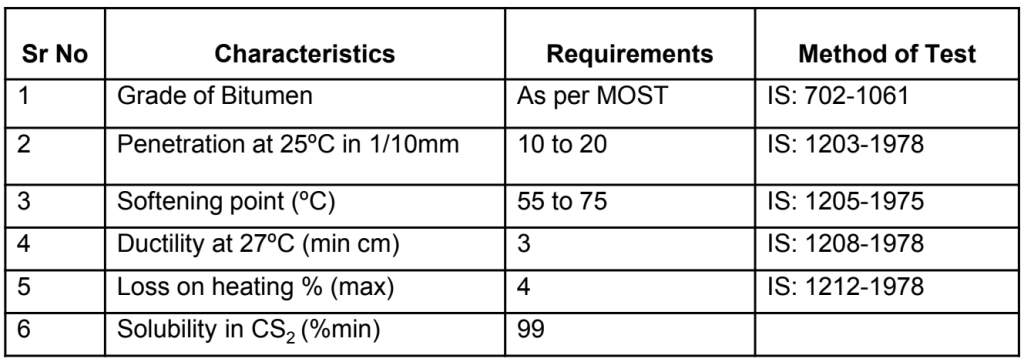
The bitumen shall be conforming to IS 702-1061 of suitable consistency having physical properties as given below.
2. Coarse Aggregate :
The coarse aggregate shall consists of clean , hard, durable, crushed rock free of disintegrated pieces , organic and other deleterious matter and adherent coatings. They shall be hydrophobic, of low porosity and satisfy the physical requirements.
3. Fine Aggregate:
The fine aggregate shall consist of crushed hard rock or natural sand or a mixture of both.
4. Filler:
The filler shall be lime stone powder passing 75microns and shall have calcium carbonate content of not less than 80% when determined as per IS: 1195-1978.
The plant consists of cold storage bins, drier, hot bin, bitumen storage tank, twin drum type mixer, control room and digital control panels. The plant is designed to provide the mastic mix as per the job mix formula. The proportioning of various components, their temperature, the weights of limestone powder, bitumen, aggregates from hot bin for each batch, mixing time, etc. are controlled through the digital control panel in the control room. It functions without violating the environmental norms of noise and dust pollution. •The plant production Capacity: 30-50 TPH.
It is an insulated, tilting steel drum provided with rotating mixing arms and heating facilities with oil fired burners for the circulations of thermal oil in its jacket. The mastic mix produced in one drum of the twin drums of the plant is poured into the transit mixer by opening the outlet gate. The mix is poured on the surface by tilting the drum. The action of mixing of components continues in the transit mixer till the mix from the plant is transported to the laying site. The capacity of a mixer is 10 T.
It is operated by a diesel engine by means of a hydraulic system. Heating of the float is done by LPG fueled infrared heaters attached to it. The special profiling with precision and smoothing zones on the float guarantees optimum laying results. The paver helps in spreading and floating the plastic mix uniformly on the surface to the desired width and thickness at correct grade and camber, through its heated, distortion free steel float and turning sword distributors. •The Paver can lay/day: •12 mm- up to 2000sq.m •25mm- 1600-1800sq.m •40 mm- 1200-1500sq.m
1. Very speedy execution drastically reducing time required for project completion.
2. Uniform and wider laying with fewer joints.
3. Road can be put to use immediately.
4. Mix is produced at the plant, away from the site. Hence, there is no handling of raw materials at site, which helps in keeping the site clean.
5. Better riding quality.
Traditionally Mastic Asphalt laying is done manually by hand using heavy wooden floats after the mix is cooked in small cookers on site.
A) Mastic Cooker: It is a modified version of Tar Boiler having compartments and oil fired burner. The central and main compartment is used for heating bitumen and for preparing the mix. The six side pockets are meant for preheating of the coarse and fine aggregates. Since heating is by oil fired burners, the temperature can easily controlled by controlling the flames or supply of the fuel.
B) Transportation: Wheelbarrows, flat mortar pans and small dumpers are used to carry the mix from cooker to the location of laying.
C) Laying: The mix is deposited directly on the prepared surface and spread uniformly by hand using wooden trowel, heavy wooden floats, hand tools, straight edge and hand level. The temperature of the mix at the time of laying shall be at least 170oC.